
 Home
Home Partners
 Clients
 Career
 Contact Us
How Odoo Helps Businesses Replace Multiple Software Tools with One Platform?
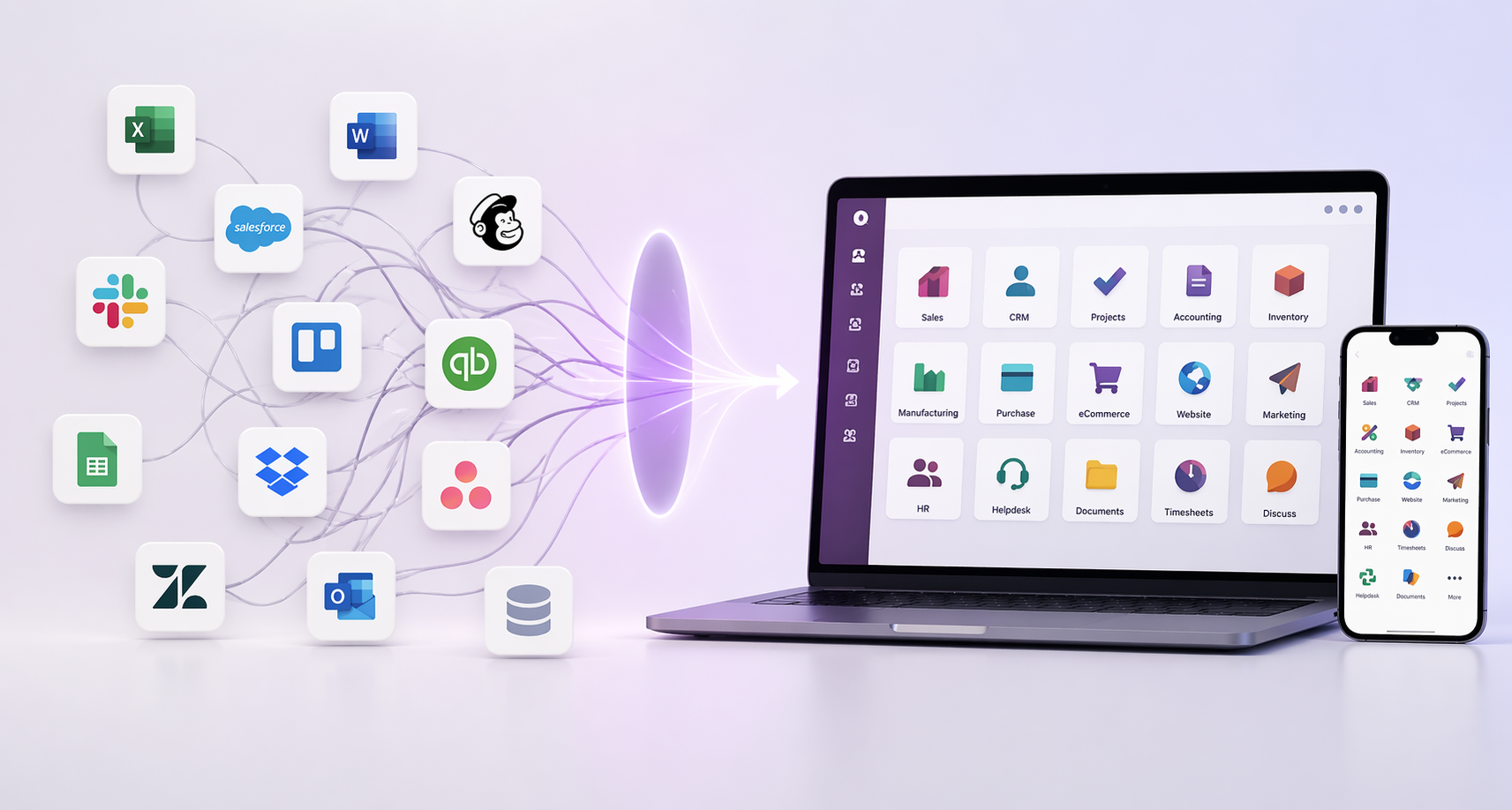
In today’s fast-paced digital landscape, businesses rely on a wide range of software tools to manage operations—accounting systems, CRM platforms, inventory trackers, HR software, eCommerce solutions, and more. While each tool serves a specific purpose, using multiple disconnected systems often leads to inefficiencies, data silos, increased costs, and operational complexity.
This is where Odoo stands out as a game-changer. Instead of juggling multiple applications, Odoo provides an all-in-one, fully integrated business management platform that allows organizations to streamline processes, improve collaboration, and scale effortlessly. Let’s explore how Odoo helps businesses replace multiple software tools with a single unified solution.
The Problem with Multiple Software Tools
Before understanding the benefits of Odoo, it’s important to recognize the challenges businesses face when using separate tools for different functions:
Data Silos
When systems don’t communicate with each other, data gets trapped in silos. This leads to inconsistencies, duplication, and difficulty in accessing real-time insights.
High Costs
Subscribing to multiple software platforms increases licensing fees, maintenance costs, and integration expenses.
Complex Integrations
Businesses often spend significant time and money integrating different tools. Even then, integrations may break or fail to deliver seamless performance.
Reduced Productivity
Employees waste time switching between applications, manually transferring data, and dealing with system inefficiencies.
Limited Scalability
As businesses grow, managing multiple tools becomes increasingly complex and difficult to scale.
What is Odoo?
Odoo is a comprehensive open-source business management software that offers a suite of applications covering all core business functions. From sales and CRM to accounting, inventory, manufacturing, HR, and marketing—everything is available within a single platform.
What makes Odoo unique is its modular structure. Businesses can start with a few applications and gradually add more as their needs grow, all while maintaining seamless integration across modules.
Key Ways Odoo Replaces Multiple Software Tools
Unified Business Operations
Odoo eliminates the need for separate tools by bringing all business processes under one roof. Instead of using different systems for sales, accounting, and inventory, businesses can manage everything within a single interface.
For example:
- Sales orders automatically update inventory
- Invoices are generated directly from sales transactions
- Customer data flows seamlessly from CRM to billing
This interconnected approach reduces duplication and ensures consistency across departments.
Integrated CRM and Sales Management
Many companies use separate CRM software alongside sales tracking tools. Odoo combines both functionalities into one system.
With Odoo’s CRM and Sales modules, businesses can:
- Track leads and opportunities
- Manage customer interactions
- Automate follow-ups
- Convert leads into sales orders effortlessly
This integration improves sales efficiency and provides a complete view of the customer journey.
Built-in Accounting and Finance
Accounting is often handled through standalone software, which requires manual data entry or complex integrations. Odoo’s accounting module is fully integrated with other business functions.
Key benefits include:
- Real-time financial reporting
- Automatic invoice generation
- Bank synchronization
- Expense tracking
Because all transactions are connected, financial data remains accurate and up-to-date without manual intervention.
Inventory and Supply Chain Management
Odoo replaces traditional inventory management tools with a robust, integrated system that connects directly with sales, purchasing, and manufacturing.
Features include:
- Real-time stock tracking
- Automated reordering rules
- Warehouse management
- Barcode scanning support
This ensures better inventory control and reduces the risk of stockouts or overstocking.
Human Resource Management
Instead of using separate HR tools, Odoo offers a comprehensive HR suite that covers:
- Employee records
- Attendance tracking
- Payroll management
- Recruitment
- Performance evaluation
Having HR integrated with other modules allows businesses to align workforce management with overall operations.
eCommerce and Website Integration
Businesses often rely on third-party platforms for website management and eCommerce. Odoo provides built-in tools to create and manage websites and online stores.
With Odoo, companies can:
- Design websites using a drag-and-drop builder
- Manage product catalogs
- Process online orders
- Integrate with inventory and accounting
This eliminates the need for separate CMS and eCommerce platforms.
Manufacturing and Project Management
For manufacturing businesses, Odoo replaces specialized tools with an integrated system that manages:
- Bill of materials (BOM)
- Production planning
- Work orders
- Quality control
Similarly, project management features allow teams to:
- Track tasks and deadlines
- Collaborate in real time
- Monitor project progress
All of this happens within the same ecosystem, ensuring smooth coordination between departments.
Marketing Automation
Odoo includes marketing tools that replace standalone platforms for email marketing, social media, and campaign management.
Businesses can:
- Create email campaigns
- Automate customer journeys
- Analyze campaign performance
- Manage social media accounts
Because marketing is connected to CRM and sales, businesses can measure ROI more effectively.
Benefits of Using Odoo as a Single Platform
Centralized Data Management
All business data is stored in one place, making it easier to access, analyze, and share information across teams.
Improved Efficiency
Automation and integration reduce manual work, allowing employees to focus on more strategic tasks.
Cost Savings
By replacing multiple software subscriptions with a single platform, businesses can significantly reduce operational costs.
Scalability
Odoo grows with your business. You can start small and add modules as your requirements evolve.
Better Decision-Making
Real-time data and comprehensive reporting provide valuable insights that support informed decision-making.
Customization and Flexibility
Odoo is highly customizable, allowing businesses to tailor the platform to their specific needs without relying on multiple third-party tools.
Real-World Example
Consider a mid-sized retail business using:
- A CRM tool for customer management
- Accounting software for finances
- Inventory software for stock tracking
- An eCommerce platform for online sales
Managing these systems separately leads to inefficiencies and errors. By switching to Odoo, the business can:
- Track customers, sales, and orders in one system
- Automatically update inventory after each sale
- Generate invoices instantly
- Manage online and offline sales seamlessly
This unified approach improves operational efficiency and enhances customer experience.
Challenges to Consider
While Odoo offers numerous advantages, businesses should also be aware of potential challenges:
1. Initial Implementation Effort
Setting up Odoo and migrating data from existing systems requires careful planning.
2. Learning Curve
Employees may need time to adapt to a new system.
3. Customization Costs
Although flexible, advanced customizations may require technical expertise.
However, these challenges are typically outweighed by the long-term benefits of using a unified platform.
Why Odoo is the Future of Business Software?
The trend in business technology is moving toward consolidation and integration. Companies are increasingly looking for solutions that simplify operations rather than complicate them.
Odoo aligns perfectly with this shift by offering:
- A single source of truth for all business data
- Seamless integration across functions
- Continuous updates and improvements
- A scalable architecture for growing businesses
As digital transformation continues to accelerate, platforms like Odoo will play a crucial role in helping businesses stay competitive.
Conclusion
Managing multiple software tools can be overwhelming, costly, and inefficient. Odoo provides a powerful alternative by combining all essential business functions into one cohesive platform.
By replacing disconnected systems with an integrated solution, businesses can:
- Improve efficiency and productivity
- Reduce costs
- Enhance collaboration
- Gain better insights
- Scale with ease
Whether you’re a small business looking to streamline operations or a large enterprise aiming for digital transformation, Odoo offers a flexible and comprehensive solution to meet your needs.
In a world where simplicity and efficiency are key, adopting a unified platform like Odoo is not just a smart choice—it’s a strategic advantage.
📂 Categories
- Web developer