 Home
Home Partners
 Clients
 Career
 Contact Us
How Odoo Helps Retailers Modernize Their Business Operations?
Retail businesses are evolving faster than ever. Customers expect seamless shopping experiences, real-time inventory updates, personalized offers, fast checkout processes, and smooth integration between online and offline stores. Traditional retail systems, which often rely on disconnected tools and manual processes, struggle to keep up with these expectations.
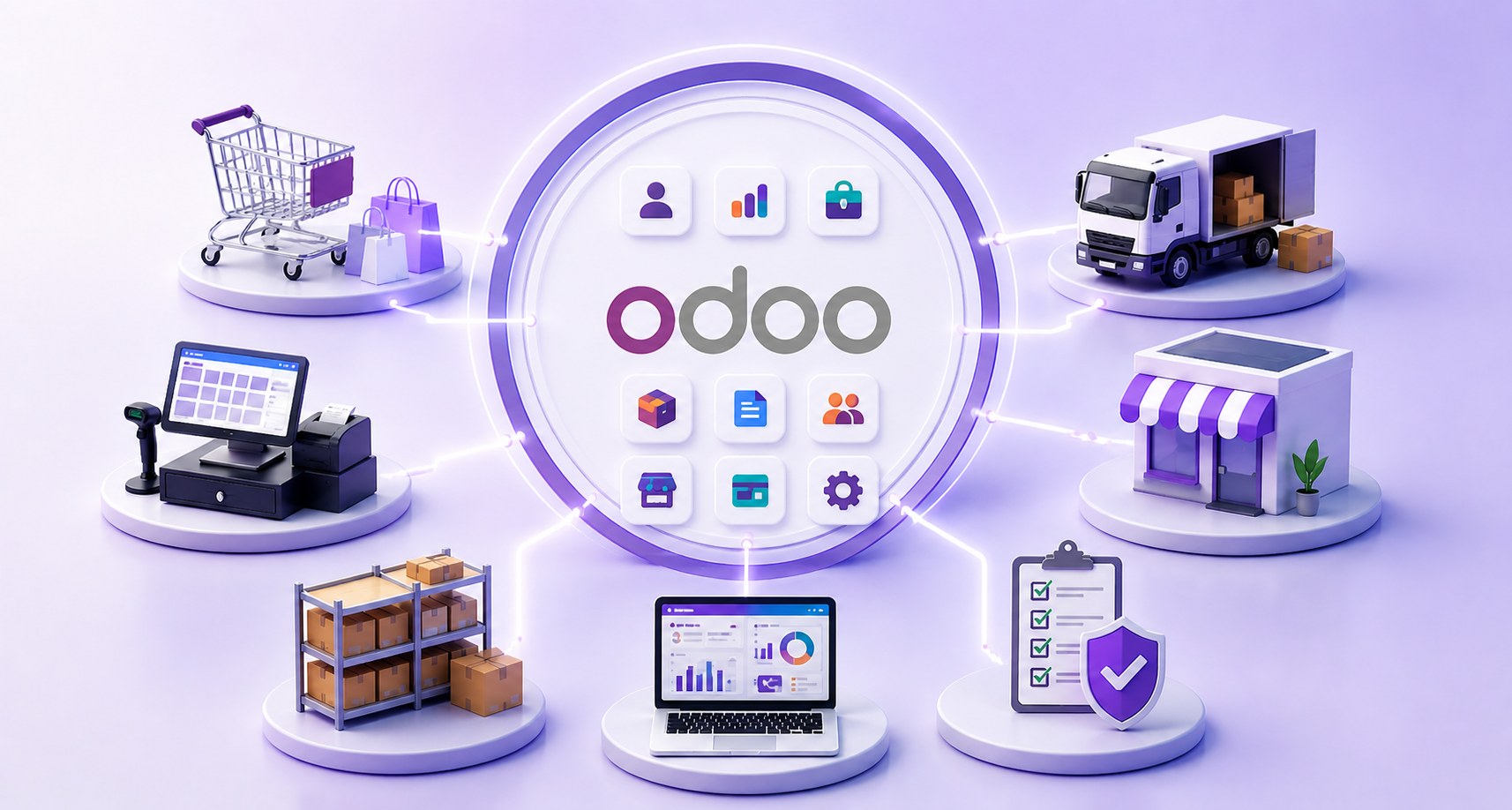
This is where Odoo ERP plays a transformative role. Odoo helps retailers modernize their entire business ecosystem by integrating sales, inventory, customer management, accounting, and e-commerce into a single, unified platform. Instead of juggling multiple systems, retailers can manage everything from one centralized dashboard.
In this blog, we will explore how Odoo helps retailers modernize their business operations, improve efficiency, reduce costs, and deliver better customer experiences.
Understanding Retail Challenges in the Modern Market
Before understanding how Odoo helps, it is important to look at the challenges retailers face today:
Disconnected Systems
Most retail businesses use separate tools for billing, inventory, CRM, and e-commerce. These systems do not communicate effectively, leading to data duplication and errors.
Inventory Management Issues
Retailers often struggle with stock inaccuracies, overstocking, or stockouts due to lack of real-time tracking.
Poor Customer Experience
Without integrated customer data, personalization becomes difficult, resulting in weak customer engagement.
Manual Processes
Many retail operations still depend on spreadsheets or manual entry, which increases operational inefficiency.
Lack of Real-Time Insights
Retailers often make decisions based on outdated reports, which affects profitability and growth.
Odoo addresses all these challenges by offering a fully integrated ERP system designed for modern retail operations.
What is Odoo ERP?
Odoo is an open-source Enterprise Resource Planning (ERP) system that provides a suite of business applications including sales, inventory, accounting, CRM, point of sale, and e-commerce.
Unlike traditional software, Odoo is modular, meaning businesses can start with a few applications and expand as needed. This makes it ideal for retail businesses of all sizes—from small shops to large multi-store chains.
How Odoo Modernizes Retail Business Operations?
Centralized Retail Management System
One of the biggest advantages of Odoo is centralization. Retailers can manage all operations from a single platform:
- Sales transactions
- Inventory tracking
- Customer records
- Supplier management
- Financial reporting
This eliminates the need for multiple disconnected tools and reduces operational complexity.
Smart Inventory Management
Inventory is the backbone of retail operations. Odoo provides real-time inventory tracking across multiple warehouses and store locations.
Key benefits include:
- Automatic stock updates after every sale
- Low-stock alerts
- Barcode scanning support
- Multi-warehouse management
- Demand forecasting tools
This ensures retailers never face stock shortages or overstocking issues.
Integrated Point of Sale (POS) System
Odoo’s POS system is designed for modern retail environments. It works both online and offline, ensuring uninterrupted sales.
Features include:
- Fast checkout process
- Multi-payment options
- Real-time synchronization with inventory
- Customer loyalty programs
- Easy product search and categorization
With this system, retail staff can process transactions quickly, improving customer satisfaction.
Seamless E-Commerce Integration
Modern retail is not limited to physical stores. Online shopping has become a major revenue channel.
Odoo helps retailers integrate their e-commerce platforms directly into the ERP system. This means:
- Online orders are automatically synced
- Inventory updates in real time
- Unified customer database
- Centralized order management
This eliminates the gap between offline and online retail operations.
Enhanced Customer Relationship Management (CRM)
Understanding customers is essential for retail success. Odoo’s CRM module helps retailers track customer interactions, preferences, and purchase history.
This enables:
- Personalized marketing campaigns
- Better customer segmentation
- Improved customer retention strategies
- Automated follow-ups and promotions
By using data effectively, retailers can build stronger customer relationships.
Automated Accounting and Financial Management
Financial management becomes much easier with Odoo’s integrated accounting module.
Retailers can:
- Automatically record transactions
- Generate invoices instantly
- Track expenses and profits
- Manage taxes and compliance
- Create real-time financial reports
This reduces manual accounting errors and improves financial transparency.
Omnichannel Retail Experience
Modern customers expect a consistent experience across all channels—online store, physical shop, mobile apps, and marketplaces.
Odoo enables omnichannel retail by:
- Synchronizing data across all sales channels
- Unifying customer experience
- Managing orders from multiple platforms in one system
This helps retailers maintain consistency and improve brand reputation.
Advanced Reporting and Analytics
>Retailers can analyze:
- Sales trends
- Best-selling products
- Customer behavior
- Inventory turnover
- Profit margins
These insights help in making better strategic decisions.
Scalability for Growing Businesses
Whether a retailer has one store or multiple branches, Odoo scales easily.
As the business grows, additional modules can be added without replacing the system. This makes it a long-term solution for retail expansion.
Cost Efficiency and Operational Savings
By replacing multiple tools with one unified system, Odoo helps reduce software and operational costs.
Retailers save money on:
- Software licenses
- IT maintenance
- Manual labor
- Inventory losses
- Data synchronization issues
This makes operations more efficient and profitable.
Real-World Impact of Odoo in Retail
Retail businesses using Odoo often experience:
- Faster billing and checkout processes
- Reduced inventory errors
- Improved customer satisfaction
- Better sales tracking
- Increased operational efficiency
It transforms traditional retail stores into modern,>Why Odoo is the Future of Retail Management?
Retail is becoming increasingly digital. Businesses that fail to adapt risk losing customers to more efficient competitors.
Odoo provides the flexibility, integration, and automation needed to keep up with modern retail demands. Its modular structure ensures that retailers can continuously evolve without replacing their entire system.
From inventory and sales to CRM and e-commerce, Odoo unifies everything into one powerful platform, making it a complete digital transformation solution for retail businesses.
Conclusion
Modern retail businesses require more than just a billing system—they need a fully integrated digital ecosystem. Odoo helps retailers achieve this by bringing all core operations into a single platform.
By using Odoo, retailers can streamline processes, reduce costs, improve customer experience, and scale efficiently. In a competitive retail environment, adopting Odoo is not just an upgrade—it is a strategic transformation.
📂 Categories
- Web developer