 Home
Home Partners
 Clients
 Career
 Contact Us
The Ecommerce Marketing Funnel That Turns Visitors Into Repeat Customers
Getting people to visit your ecommerce website is only the beginning of the customer journey. Many online businesses invest heavily in advertising, social media, and SEO to drive traffic but struggle to convert visitors into paying customers. Even after making a sale, they often fail to bring customers back for future purchases.
This is where a well-planned ecommerce digital marketing funnel becomes essential. Instead of focusing on one-time sales, an effective funnel guides potential customers through every stage of their buying journey—from discovering your brand to becoming loyal advocates.
At Yuvmedia, we believe that sustainable ecommerce growth is achieved by building relationships, not just generating clicks. Let's understand how an ecommerce marketing funnel works and why it is one of the most powerful strategies for long-term success.
What Is an Ecommerce Marketing Funnel?
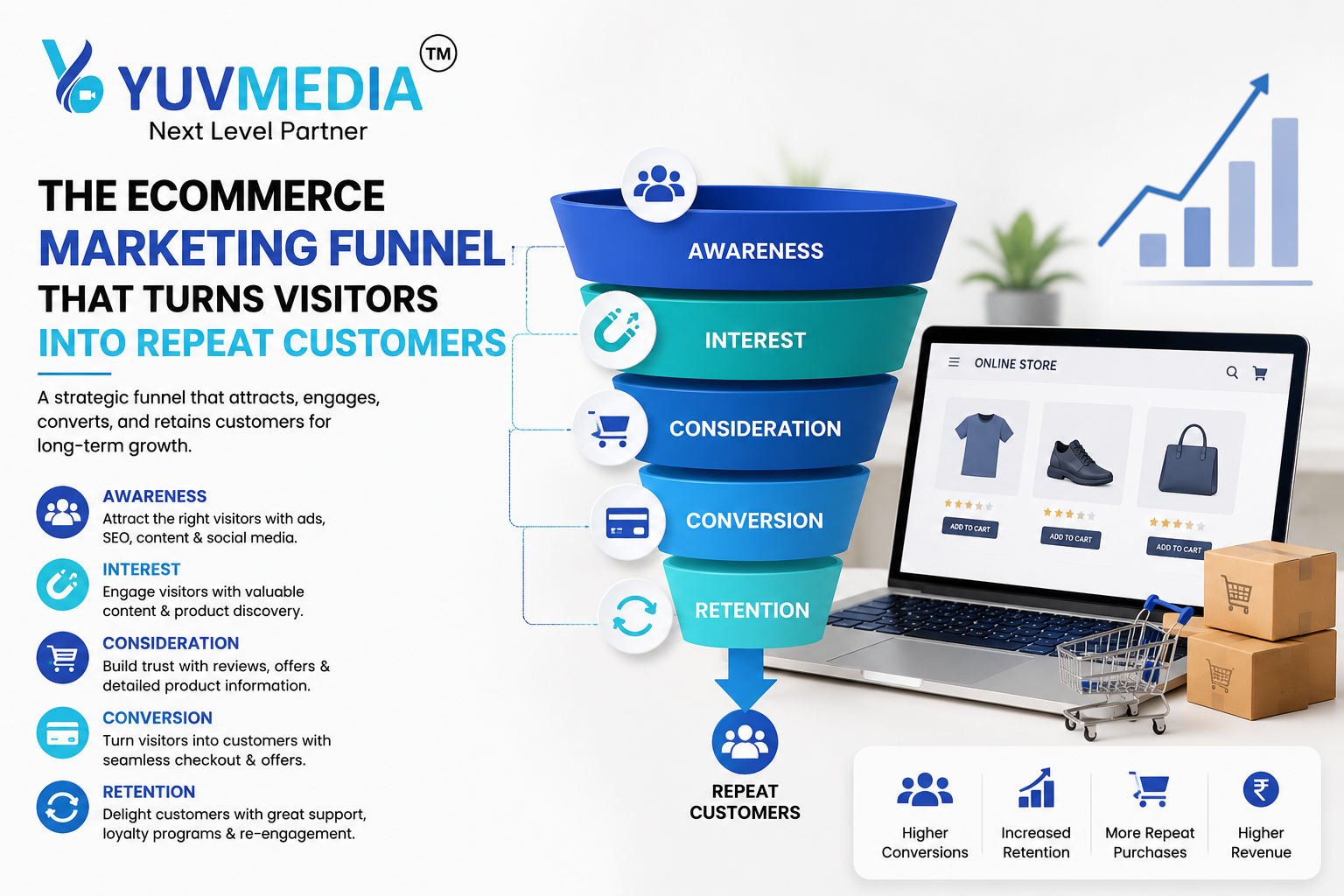
An ecommerce marketing funnel is a structured process that moves potential customers through different stages before and after they make a purchase. Each stage is designed to answer customer questions, build trust, reduce hesitation, and encourage repeat business.
Unlike traditional marketing, which often ends after a sale, ecommerce digital marketing continues nurturing customers to increase lifetime value and brand loyalty.
Stage 1: Awareness – Attract the Right Audience
The first step is making potential customers aware of your brand. However, attracting random visitors isn't enough—you need qualified traffic from people who are genuinely interested in your products.
Businesses can increase awareness through:
- Search Engine Optimization (SEO)
- Google Ads
- Social Media Marketing
- Content Marketing
- Influencer Collaborations
- Email Campaigns
A strong awareness strategy ensures that the right audience enters your funnel instead of wasting marketing efforts on irrelevant traffic.
Stage 2: Interest – Build Trust Immediately
Once visitors land on your website, they decide within seconds whether they want to stay or leave.
This stage focuses on creating confidence through a professional shopping experience.
Key elements include:
- Fast-loading website
- Mobile-friendly design
- Clear product categories
- Professional product photography
- Detailed product descriptions
- Customer testimonials
- Trust badges and secure payment icons
An optimized website helps visitors explore products comfortably and encourages them to continue their buying journey.
Stage 3: Consideration – Remove Buying Doubts
Many customers compare multiple brands before making a purchase. During this stage, your goal is to answer every question that could prevent someone from buying.
Effective strategies include:
- Frequently Asked Questions (FAQs)
- Product comparison guides
- Video demonstrations
- Size charts
- Return and refund policies
- Customer reviews
- Live chat support
The easier it is for customers to find answers, the more likely they are to complete their purchase.
Stage 4: Conversion – Make Checkout Effortless
Even customers who add products to their cart may abandon their purchase if the checkout process is complicated.
Your checkout experience should be simple, fast, and secure.
Best practices include:
- Guest checkout option
- Multiple payment methods
- Minimal form fields
- Transparent shipping charges
- Quick order confirmation
- Secure payment gateway
A smooth checkout process reduces cart abandonment and improves conversion rates significantly.
Stage 5: Retention – Turn Buyers Into Loyal Customers
Many ecommerce businesses stop marketing after the first purchase. This is one of the biggest mistakes in ecommerce digital marketing.
Acquiring a new customer often costs much more than retaining an existing one. That's why customer retention should be a priority.
Retention strategies include:
- Personalized email campaigns
- Product recommendations
- Loyalty rewards
- Birthday and festive offers
- Exclusive discounts for returning customers
- Re-engagement campaigns
Consistent communication keeps your brand fresh in customers' minds and encourages repeat purchases.
Stage 6: Advocacy – Let Customers Market Your Brand
Satisfied customers can become your most valuable marketing asset.
When customers have a positive experience, they naturally recommend your products to friends, family, and colleagues.
Encourage advocacy by:
- Asking for product reviews
- Creating referral programs
- Sharing user-generated content
- Offering referral rewards
- Engaging with customers on social media
Word-of-mouth marketing builds credibility and attracts high-quality customers without increasing advertising costs.
Why Analytics Is Essential Throughout the Funnel
A marketing funnel should never remain static. Customer behavior changes over time, and your strategy should evolve accordingly.
Monitor important performance metrics such as:
- Website traffic
- Bounce rate
- Cart abandonment rate
- Conversion rate
- Customer Lifetime Value (CLV)
- Return on Ad Spend (ROAS)
- Repeat purchase rate
Analyzing these metrics helps identify weak points in your funnel and allows continuous optimization for better results.
How Yuvmedia Builds High-Performing Ecommerce Funnels
At Yuvmedia, we understand that successful ecommerce businesses require more than attractive advertisements. We create end-to-end ecommerce digital marketing strategies that guide customers through every stage of the buying journey.
Our services include SEO, paid advertising, conversion rate optimization, content marketing, email automation, social media management, and performance analytics. By integrating these elements into a single funnel, we help businesses increase conversions, improve customer retention, and maximize long-term revenue.
Whether you're launching a new ecommerce store or scaling an existing one, Yuvmedia develops marketing funnels tailored to your business goals and customer behavior.
Conclusion
Driving traffic to your website is only the first step in ecommerce success. The real challenge lies in converting visitors into customers and keeping them engaged long after their first purchase.
A well-designed ecommerce digital marketing funnel creates a seamless customer journey by attracting the right audience, building trust, simplifying purchasing decisions, and encouraging repeat business. Businesses that invest in every stage of the funnel are better positioned to increase customer loyalty, reduce acquisition costs, and achieve sustainable growth.
If your ecommerce strategy focuses only on getting clicks, you're leaving valuable opportunities on the table. Build a complete marketing funnel, and you'll create customers who return again and again.
To get more information visit our Company : YUVMEDIA- Digital Marketing Services