
 Home
Home Partners
 Clients
 Career
 Contact Us
What Problems Can ERP Software Solve in Business Operations?
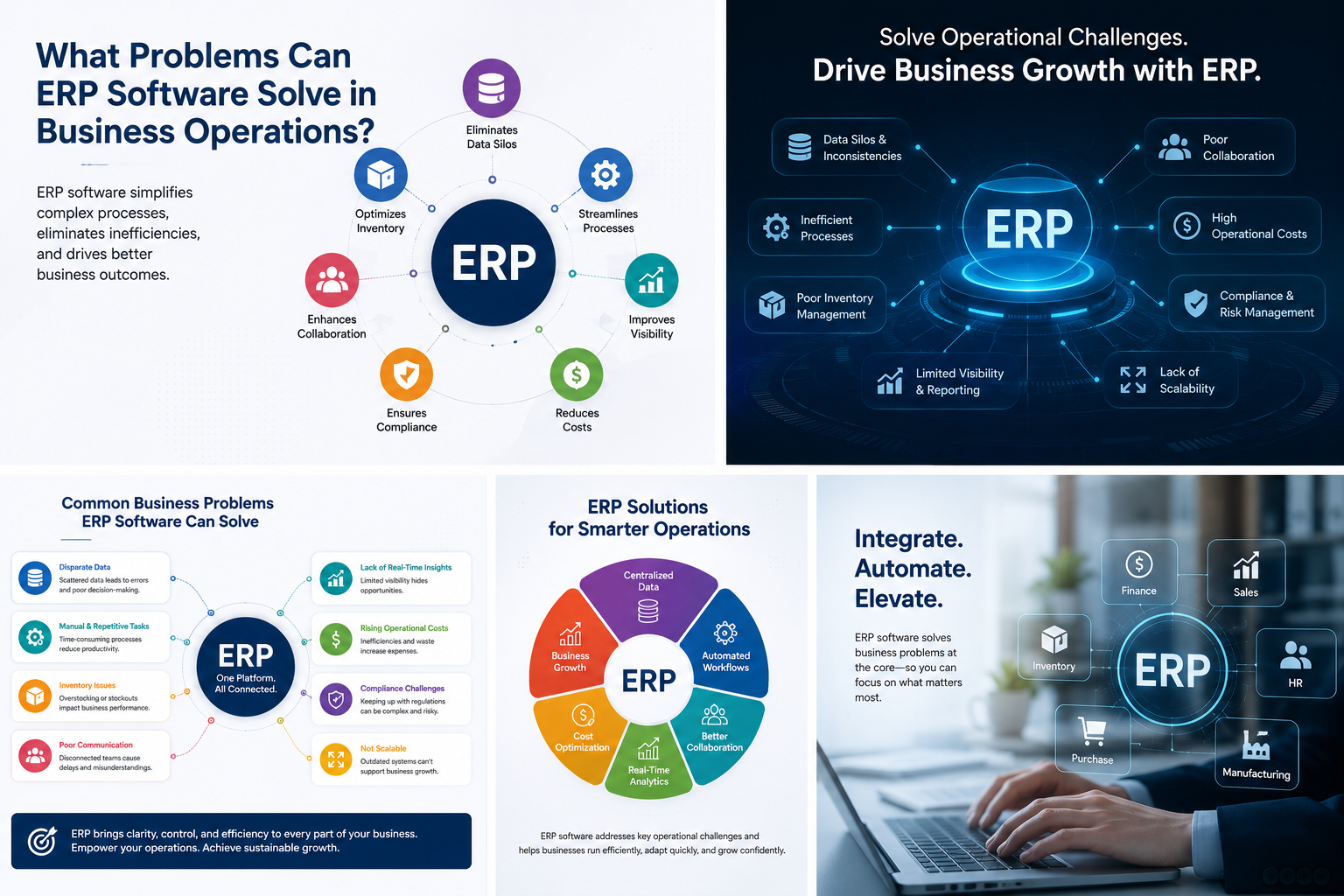
Every business starts out relatively simple. In the early days, a handful of spreadsheets, a basic accounting app, and a shared group chat are usually enough to keep the wheels turning. But as a business begins to scale, these makeshift, disconnected tools quickly turn into your biggest operational nightmare.
Teams struggle to locate accurate data, compiling a simple performance report takes weeks, and one tiny rel="noopener noreferrer" target="_blank" >erp enterprise resource planning solution steps in to save the day.
Instead of forcing your team to juggle a dozen separate tools, an ERP brings your entire workflow into one centralized platform. Sales, stock, finance, and HR finally talk to each other in real-time, shifting your focus away from daily firefighting and back toward actual growth.
5 Critical Operational Problems an ERP Solves
Many business owners don’t realize how much revenue, time, and team productivity they lose every single day to fractured internal processes. Investing in professional enterprise resource planning services helps eliminate these 5 common operational headaches:
1. The "Where is the Data?" Dilemma (Zero Visibility)
The biggest operational mess happens when your sales team uses one application, warehousing uses another, and your accounts team uses something completely different. Everyone ends up working with conflicting numbers. An ERP creates a single source of truth. Because every department looks at identical, real-time data, internal friction and finger-pointing vanish completely.
2. Drowning in Manual, Repetitive Tasks
Manually creating invoices, copying over stock numbers, and typing out purchase orders eats up hours of your employees' day. A modern ERP automates these routine administrative chores. When the system handles the busywork, human errors plummet, and your team is freed up to focus on high-value strategy and customer satisfaction.
3. The Inventory "Boom or Bust" Cycle
Managing inventory without clear data is pure guesswork. If you hoard stock, you tie up valuable cash flow; if you under-order, you face backorders and angry customers. An ERP gives you live visibility into stock levels, making it easy to forecast demand, prevent shortages, and maintain optimal inventory levels at all times.
4. Rigid Software That Doesn’t Fit Your Workflows
Generic, off-the-shelf software often forces you to change the way you run your business just to adapt to the technology. Tailored erp development services solve this problem completely. By developing customized modules, dashboards, and unique workflows, you build a system that conforms to your specific industry needs, rather than forcing your business to bend to a rigid tool.
5. Delayed, Outdated Reporting
When you need to make a critical business decision, you shouldn't have to wait days for individual departments to compile and format Excel sheets. By the time those reports hit your desk, the data is already old news. An ERP provides live dashboards, giving you instant access to your financial health, sales performance, and operational efficiency with a single click.
Why Is Everyone Moving Toward Odoo Services?
Among the various ERP solutions on the market, Odoo has skyrocketed in popularity for growing businesses, and the reason boils down to one word: flexibility.
By partnering with professional providers for odoo services, businesses don’t have to buy a massive, overly complicated system all at once. You can start small by implementing just the core modules you need today—like CRM, Inventory, or Accounting—and seamlessly plug in new features (like manufacturing or e-commerce) as your operation expands. It is fully customizable and designed to grow at your pace.
Overcoming the Fear of a Messy Software Transition
Many founders hesitate to adopt a new system because they dread employee resistance or data loss during migration. This is where expert erp implementation services become essential.
Professional implementation consultants handle the technical heavy lifting. They map out your current workflows, safely migrate your legacy data, configure the security settings, and train your staff to ensure an easy transition with a fast return on your investment.
The Bottom Line
Running a successful business isn't just about working harder; it's about building smarter infrastructure. An ERP isn't an arbitrary software expense—it’s a foundational asset for your company's future. If you are tired of fragmented applications, data silos, and daily operational bottlenecks, it’s time to retire the spreadsheets and transition to a unified ERP ecosystem.
Frequently Asked Questions (FAQs)
Q1: How do I know if my small business actually needs an ERP system?
A: If your team spends hours doing double data entry across different apps, you frequently run out of popular stock items, or you can’t get an instant, accurate picture of your daily sales and profits without chasing down multiple spreadsheets, your business has officially outgrown its basic tools.
Q2: What is the difference between ERP software and standard accounting software?
A: Accounting software only manages money—invoices, expenses, and tax ledgers. An ERP manages your entire business. It links your financial data directly with your live inventory, active sales pipeline, manufacturing schedules, and HR payroll into one single brain.
Q3: Can an ERP system be customized to fit my specific industry?
A: Yes, absolutely. With tailored erp development services, consultants can build custom features, unique workflows, and industry-specific dashboards. This ensures the system molds itself perfectly around your existing operations rather than forcing you to change your workflow.
Q4: Why should we choose Odoo services over older, legacy ERPs?
A: Traditional legacy ERP systems are notoriously heavy, rigid, and expensive to set up all at once. Professional odoo services offer a modular approach—meaning you only pay for and implement the apps you need today (like CRM or Billing), and easily add more modules later as your budget and business expand.
Q5: How long does a typical ERP implementation take?
A: It depends on the size of your business and complexity, but a standard implementation usually takes anywhere from a few weeks to a few months. Working with dedicated erp implementation services speeds up this process, as they handle the data migration, system testing, and staff training smoothly to minimize downtime.
📂 Categories
- ERP Services