
 Home
Home Partners
 Clients
 Career
 Contact Us
Why Most Ecommerce Stores Fail Despite Spending on Ads (And How to Avoid It)
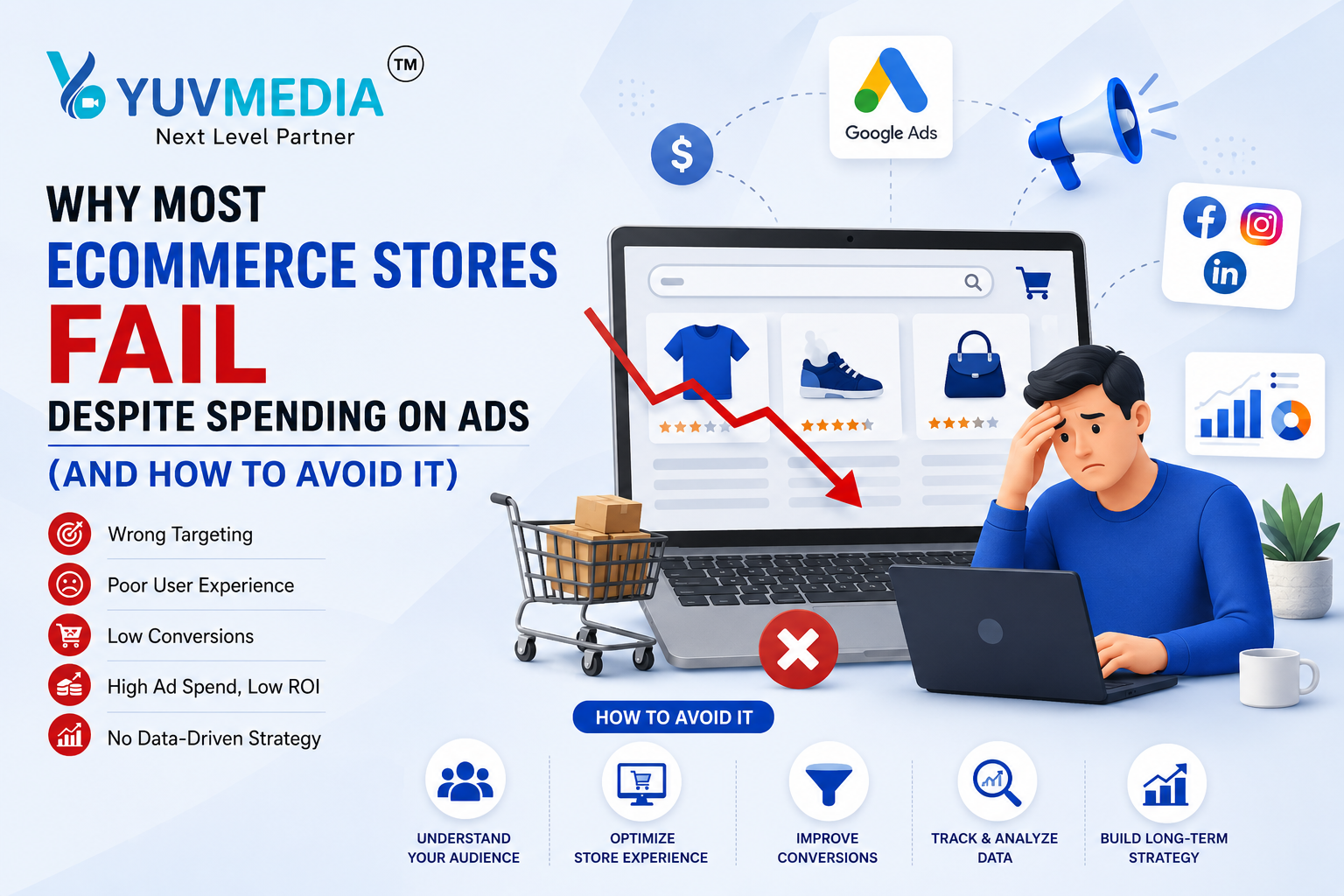
Launching an online store has never been easier, but building a profitable ecommerce business is a completely different challenge. Every day, thousands of businesses invest heavily in Google Ads, Meta Ads, and influencer campaigns, expecting instant sales. Unfortunately, many ecommerce stores burn through their marketing budgets without seeing meaningful returns.
The problem isn't always the advertising itself. In most cases, the real issue lies in the overall ecommerce digital marketing strategy. Paid advertisements can drive visitors to your website, but they cannot guarantee conversions if your store isn't prepared to convert those visitors into customers.
Let's explore the most common reasons ecommerce businesses fail despite spending on ads—and how you can avoid making the same mistakes.
1. Driving Traffic Without Understanding Your Audience
One of the biggest mistakes ecommerce brands make is targeting everyone instead of the right audience.
Successful advertising starts with understanding your customers. Their interests, buying behavior, age group, shopping habits, and pain points all influence whether they'll make a purchase.
Without proper audience research, even the best-designed ad campaigns can generate clicks that never become sales.
How to avoid it:
Create detailed customer personas.
Use audience insights from Google Analytics and Meta Ads Manager.
Segment campaigns for different customer groups instead of running one generic advertisement.
2. Focusing Only on Clicks Instead of Conversions
Many store owners celebrate high website traffic while ignoring conversion rates.
A campaign that generates 20,000 visitors means very little if only a handful of people complete a purchase.
The real objective of ecommerce digital marketing isn't attracting visitors—it's converting visitors into loyal customers.
Improve conversions by focusing on:
Fast-loading pages
Clear product descriptions
High-quality product images
Easy checkout process
Strong product reviews
Trust badges and secure payment options
3. Weak Product Pages That Don't Build Trust
Imagine clicking an attractive advertisement only to land on a product page with blurry images, short descriptions, and no customer reviews.
Most shoppers leave within seconds.
Your product page acts as your salesperson. It must answer customer questions before they even ask them.
Include:
Multiple product images
Feature and benefit-focused descriptions
Customer reviews
Shipping information
Return policies
Frequently asked questions
A trustworthy product page significantly improves conversion rates.
4. Ignoring SEO While Depending Entirely on Paid Ads
Many ecommerce businesses believe paid advertising alone will drive long-term growth.
This approach becomes expensive because traffic stops the moment advertising budgets are paused.
Instead, businesses should combine paid advertising with search engine optimization.
A balanced ecommerce digital marketing strategy includes:
SEO-optimized product pages
Keyword-focused blog content
Internal linking
Technical SEO
Organic content marketing
Organic traffic helps reduce customer acquisition costs over time.
5. Poor Mobile Shopping Experience
More than half of ecommerce purchases now happen on smartphones.
If your website loads slowly, has confusing navigation, or makes checkout difficult on mobile devices, customers are likely to abandon their carts.
Improve the mobile experience by:
Compressing images
Simplifying navigation
Using mobile-friendly layouts
Offering one-page checkout
Enabling multiple payment methods
A smooth mobile experience often results in higher sales without increasing advertising spend.
6. No Customer Retention Strategy
Many ecommerce brands spend all their resources acquiring new customers while forgetting about existing ones.
Returning customers are typically more valuable because they already trust your brand and often spend more.
Build long-term relationships using:
Email marketing
Loyalty programs
Personalized recommendations
Exclusive discounts
Cart abandonment emails
Product replenishment reminders
Customer retention lowers marketing costs and increases lifetime value.
7. Ignoring Data and Campaign Performance
Successful ecommerce brands constantly analyze campaign performance.
Instead of guessing what works, they monitor important metrics such as:
Conversion rate
Cost per acquisition (CPA)
Return on Ad Spend (ROAS)
Average order value
Bounce rate
Customer lifetime value
These insights help marketers improve campaigns instead of repeatedly making expensive mistakes.
How Yuvmedia Helps Ecommerce Businesses Grow
At Yuvmedia, we believe successful ecommerce growth requires more than simply running advertisements.
Our ecommerce digital marketing approach combines performance marketing, SEO, content strategy, conversion rate optimization, social media marketing, and customer retention techniques to create sustainable business growth.
Rather than focusing only on clicks, we help businesses generate qualified traffic, improve user experience, and maximize every marketing investment.
Whether you're launching a new ecommerce brand or scaling an existing online store, a well-planned strategy can make all the difference.
Conclusion
Paid advertising is only one part of a successful ecommerce business. Without the right audience, optimized website, compelling product pages, SEO strategy, and ongoing performance analysis, advertising budgets can quickly disappear without delivering meaningful results.
The brands that succeed understand that ecommerce digital marketing is a complete ecosystem—not just a collection of paid campaigns. By combining>To get more information visit our Company : YUVMEDIA- Digital Marketing Services